Posted On: Tuesday - December 23rd 2025 7:11PM MST
In Topics: History The Future Books Muh Generation
It's about damn time ... for a book review of 2 books I read in the late 1990s and early '00s! This is also long in coming in that I've written probably a half dozen times here on Peak Stupidity that I'd have a review of the books, Generations and The Fourth Turning, errrr, any day now. (They go together, and there are now 3 other books I believe, that these authors, or one of them, have written on the same subject that I haven't read.) Today is that day ... well, bleeding into tomorrow too.
Is it feasible to do a book review of 2 books I've read a couple of times 20 and nearly 30 years ago? In this case, I think so. The main and very interesting theme of these books is very well known at this point, explained well on this wiki page on "Generational Theory" for your or my reference. Therefore, in this post, I'll do my best to explain that simply, and in at least one further post, I'll review the books. Keep in mind, that, as interesting as all this is, I am not really down with the whole idea, and the book review will not be all favorable.
Strauss & Howe's big idea is that the history and future history of the Anglo, British and then American*, people, can be described not as a linear progression, but as a cyclic process. I would describe it as a spiral, as there's no contention by these writers that things return, economically, politically, etc. to their same state after each cycle, but we'll use the terminology that's in the books. There's LOTS of terminology in these very organized view of the cycles, the 4 periods ("turnings") within each cycle, and the 4 different archetypical peoples of the different generations that are each in 1 of 4 stages of life progression during each. Whewww! Don't worry - there are lots of tables.
It's so neatly tied up that there are people that seem to take this series of books, or say Generational Theory, as their bible. One I recall is the pundit Jim Quinn, featured on ZeroHedge still (after my seeing him on there over a dozen years ago too) with writing from his Burning Platform blog. (I generally agree with his views.) Steve Bannon is also said to be an acolyte. Another reason one might think of these books as some sacred texts is that if he had read them soon after they were published, they would seem pretty darned prescient at this point or even 20 years ago. I'll get to this in the review.
Again, you could just read the wiki page, but I hope the reader will get this quick summary and use the wiki page for more reference.
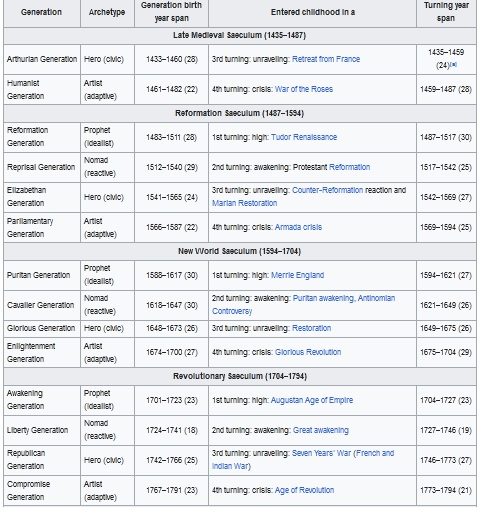
Here's the gist of Strauss & Howe's Generational Theory: The cycles of Anglo-American history, or "saecula", are about 85 years long, a long human lifespan. Each of them contains 4 roughly generation-long (21 1/4 year average) periods within called "turnings", a term that is unfortunately confusing. One would think that turnings would be the short periods when society goes from one of these 4 periods to the next, but a 'turning" IS the period itself, hence the name of the 2nd book I read. There are 4 TYPES of turnings only, Highs, Awakenings, Unravellings, and Crises**, but each individual turning is named and associated with a generation, such as Baby Boom generation, that name referring to the people born during that 20-odd year period, during the Great Depression and WWII crisis. That "Boomer" generation was probably the first widely known by a name, well before these books, but Messrs Strauss & Howe got pretty creative in naming the 25 generations from WAY BACK WHEN to today's infants. That's half a Millenia worth of generations.
Back to the saecula, they are all named too, going back to before the Reformation, yes, THAT Reformation. The start of this known cyclic history (?) is the last 2 turnings of the Late Medieval Saeculum going back to the year 1435. The authors just describe the Unraveling Turning, named Retreat from France, and the Crisis Turning, named War of the Roses.
The Reformation Saeculum is the only one that completely took place in the Old World still, England, that is. Within that one, just as one example (the rest being in the tables) there were these generations in the corresponding turnings: The Reformation Generation (has a nice ring to it) was born roughly during the Tudor Renaissance HIGH turning. By "roughly", I don't mean the generation in question had a hard time coming through their respective birth canals here, but the periods when the different generations were born correspond roughly, but not exactly, to the turnings to which they are attached in the tables.
Next, there were the Reprisal Generation, born during the Protestant Reformation AWAKENING turning, the Elizabethan Generation, born during the Counter-Reformation Reaction and Marian Restoration UNRAVELING turning, and the Parliamentary Generation, born during the Armada Crisis, well CRISIS turning. Not all the names of the generations are so political in nature, BTW.
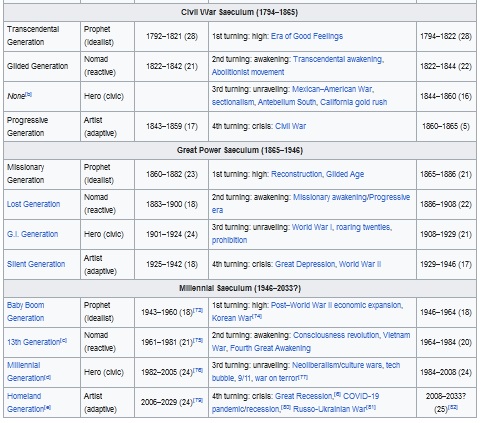
These turnings (periods, remember) and generations are so far back in history that it's difficult for anyone but a Historian of Britain to make sense of it, so I'll do the same for the most recent COMPLETED saeculum - that'd be the Great Power Saeculum, which went on from 1865 to 1946. I'll phrase it differently in case that helps, but I'll also add in the "archetype" for each generation, something we'll get to shortly.
The HIGH turning, the Reconstruction***, Gilded Age (1865 - 1886), was the period, approximately, when the Missionary Generation (of Prophet archetype) were born (1860 - 1885). The AWAKENING turning, the Missionary Awakening/Progressive Era (1886 - 1908), was when the Lost Generation (of Nomad archetype) were born (1883 - 1900). The UNRAVELING turning, World War I, Roaring Twenties, Prohibition (1908 - 1929), was when the G.I. Generation (of Hero archetype) were born (1901 - 1924). The final, CRISIS turning of the Great Power Saeculum was The Great Depression, World War II (1929 - 1946), when the Silent Generation (of Artist archetype) were born (1925 - 1942).
About the archetypes now, the theory is that the mentality, I guess one could put it, of the many generations in history changes in a cyclic fashion too, and among 4 archetypes. The archetypivity, if I may, is both the cause of the direction of society during the turnings in which they live and is determined by the stages of life (again of 4 stages - so very neat and organized!) that these "cohorts" in a generation undergo during each turning of their lives. (So, go the turnings of their lives, goes the old American
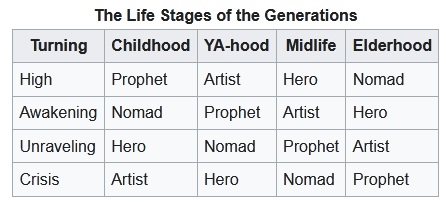
In this way, with both causation and effect being functions of these many generations' stages of life as the cyclic societal periods go by, Strauss & Howe distance their theory from a basic long-term horoscope.
Strauss & Howe made a great effort to explain why people born during certain types of periods (turnings), and not just that, but are young adults during other certain periods, in midlife during others, and old during others, act as they do, generally. (This theory is not a big complex high-brow horoscope - that should be duly noted on the back covers of the books.) Note that "generally" I wrote - Strauss & Howe are not absolutists, but still, in the review, I'll explain a couple of reasons the pigeonholing of people into named generations is generally bunk.
What these writers are very common-sensical about is that they don't draw out solid round-numbered years for the saecula, turnings, and generations. There's some shrinking and stretching of the periods to match history, and I don't see that as cheating. As one real off-theory exception, the Civil War Saeculum has its 4 turnings but with only 3 generations attached. This saeculum is only 72 years long. It's Nomad-archetype Gilded Generation is followed by the Artist-archetype Progressive Generation, with no Hero-archetype generation in between. I give them credit for making it all fit and for seeing and dealing with an appropriate exception to their neat 4-of-everything theory.
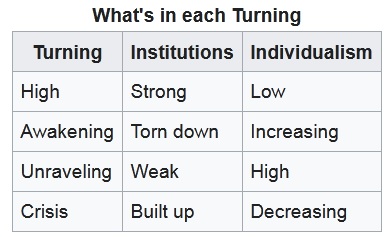
That small table, taken from the wiki page, shows one aspect of society that is said to be changing through each saecula, ending up at the same level at the same turning every time around. The book presents many more aspects. All are explained by the presence of the 4 different archetypes of people being in their certain stages of life at the time. Permissiveness of parents is one example. Because society is like "this" during an Awakening, the Artist parents are more permissive, and their Nomad kids grow up to be like "this", which means that in the next turning, "this" will happen, etc. It goes on like that, everything is neat cycles of history.
I'll leave the big table below for the reader to peruse. If this Generational Theory developed by Strauss & Howe seems too hokey already, you can stop here. Our review will appear tomorrow, hopefully, if you want to know more to decide whether these books might be good reading.
* The reader may already see a problem with this theory coming into play right here. If these book are to predict the future of THESE people, how does that work after the massive immigration changes to our demographics? We'll get to this in the review.
** The authors make a comparison of the 4 turnings of a saeculum to seasons of the year. A High is compared to Spring, an Awakening to Summer, an Unraveling to Fall, and a Crisis to Winter.
*** I don't at all see the so-called "Reconstruction" of the South being any part of a HIGH, not for anyone involved!
Comments:
Moderator
Wednesday - December 24th 2025 2:27PM MST
PS: "The attitude of the world to the "good news" may differ of course." Indeed. Thanks, M.
The Alarmist
Wednesday - December 24th 2025 11:33AM MST
PS
“And when I compare, I see today’s counterparts as very often wanting….”
I sometimes ask in meetings, when some simp makes a comment about what “we” should be doing in the world in places like 404, “Show of hands, who here has been shot at?”
Back in JFK’s day, our fathers’ or grandfathers’ day, more than a few hands would go up. Many of the film and TV stars of yesteryear were WW2 veterans, more than a few with combat experience. Our forebears were for the most part in the sh¡t at some point in their lives, be it the GD1.0, WW2, Korea, or even Vietnam.
Today’s counterparts for the most part haven’t experienced much more than a stubbed toe. It will be interesting to see how they hold up when TSHTF.
The only criticism I might level at S&H is that they might be off on the timing, but there is little question that cycles run through all our history (not just Anglo-American), and demographic changes are sometimes perhaps little more than noise or sometimes the change-agents themselves.
🕉
“And when I compare, I see today’s counterparts as very often wanting….”
I sometimes ask in meetings, when some simp makes a comment about what “we” should be doing in the world in places like 404, “Show of hands, who here has been shot at?”
Back in JFK’s day, our fathers’ or grandfathers’ day, more than a few hands would go up. Many of the film and TV stars of yesteryear were WW2 veterans, more than a few with combat experience. Our forebears were for the most part in the sh¡t at some point in their lives, be it the GD1.0, WW2, Korea, or even Vietnam.
Today’s counterparts for the most part haven’t experienced much more than a stubbed toe. It will be interesting to see how they hold up when TSHTF.
The only criticism I might level at S&H is that they might be off on the timing, but there is little question that cycles run through all our history (not just Anglo-American), and demographic changes are sometimes perhaps little more than noise or sometimes the change-agents themselves.
🕉
M
Wednesday - December 24th 2025 9:57AM MST
PS
The Reconstruction period is probably considered a "high" because it gives you lots of missionaries.
Whose attitude is to go forth and bring the "good news" to the world.
The attitude of the world to the "good news" may differ of course.
The Reconstruction period is probably considered a "high" because it gives you lots of missionaries.
Whose attitude is to go forth and bring the "good news" to the world.
The attitude of the world to the "good news" may differ of course.
Moderator
Wednesday - December 24th 2025 6:19AM MST
PS: I'll get into your first part in the review (hopefully today), SafeNow.
Regarding that Americans aren't the Americans in character that they were during your day, I don't know if they specific qualities that S&H say repeat over the cycles are something we could address. I read these books long ago - I think it would take reading them.
Regarding that Americans aren't the Americans in character that they were during your day, I don't know if they specific qualities that S&H say repeat over the cycles are something we could address. I read these books long ago - I think it would take reading them.
SafeNow
Tuesday - December 23rd 2025 11:44PM MST
PS
“* The reader may already see a problem with this theory coming into play right here. If these book are to predict the future of THESE people, how does that work after the massive immigration changes to our demographics?….”
- Mr. Moderstor first footnote
Exactly! And, to demographic changes, I would add technological changes. But demographic change is the big one.
I read the Wiki article. I paid special attention to the “reception” section (criticisms by scholars and other notables). A recurring theme is that the theory, while interesting and even compelling to non-historians, has been
ridiculed by prominent historians.
I will however say this, from my observations way back in the day. I compare my observation of the energies, attitudes, moral character, and courage, of JFK, and of the regular-guy dads on my own cul-de-sac, with their counterparts today. And when I compare, I see today’s counterparts as very often wanting. The two cohorts are definitely quite different. I just don’t think generational theory explains it.
“* The reader may already see a problem with this theory coming into play right here. If these book are to predict the future of THESE people, how does that work after the massive immigration changes to our demographics?….”
- Mr. Moderstor first footnote
Exactly! And, to demographic changes, I would add technological changes. But demographic change is the big one.
I read the Wiki article. I paid special attention to the “reception” section (criticisms by scholars and other notables). A recurring theme is that the theory, while interesting and even compelling to non-historians, has been
ridiculed by prominent historians.
I will however say this, from my observations way back in the day. I compare my observation of the energies, attitudes, moral character, and courage, of JFK, and of the regular-guy dads on my own cul-de-sac, with their counterparts today. And when I compare, I see today’s counterparts as very often wanting. The two cohorts are definitely quite different. I just don’t think generational theory explains it.
The HERO archetypes are those who are in Young Adulthood during the CRISIS turning. That'd be these snowflakes? They are supposed to be the heroes? I don't know about that...
Hmmm, I'm not sure I'll get to the review tonight. Maybe.